
Research
I am mostly interested in quantitative macroeconomics and firm dynamics. My ongoing work shows how the choices of heterogeneous firms in frictional labour markets generate sizeable macroeconomic effects.Working Papers:
Costs of Adjustment and Firms' Responsiveness: Evidence from a Labour Market Reform
[Under Review]
Abstract: Following the European debt crisis various countries added more flexibility to their labour markets in an attempt to boost productivity. However, in Portugal the distribution of labour productivity has remained unchanged even after a comprehensive reform effectively slashed labour adjustment costs. Why did this happen? Is productivity immune to changes in adjustment costs which constrain firms’ labour demand decisions? I study this puzzling development with a dataset of Portuguese firms. While relying on a revenue function estimation exercise I identify the unobserved profitability shocks in the data and show that firms actually respond more to those exogenous innovations in the period following the reform: the responsiveness coefficient in the employment policy function nearly doubled. Importantly, I also document a significant fall in the curvature of firms’ revenue function in the post-reform period. I trace this back to a more inelastic demand schedule which raises markups. Since lower costs of labour adjustment and increasing product market power have disparate effects on allocative efficiency and productivity, I develop and estimate a structural model of firm dynamics to disentangle those. A counterfactual exercise demonstrates that, although in opposite directions, reduced costs of adjustment and a falling curvature exert quantitatively similar effects on the variance of labour productivity, a measure linked to misallocation. The flat dispersion observed in the data emerges as a tension between these channels: a more flexible labour market enhances firms’ employment responsiveness to shocks but the corresponding effects on allocation and productivity are offset by a concurrent increase in market power
Work in Progress:
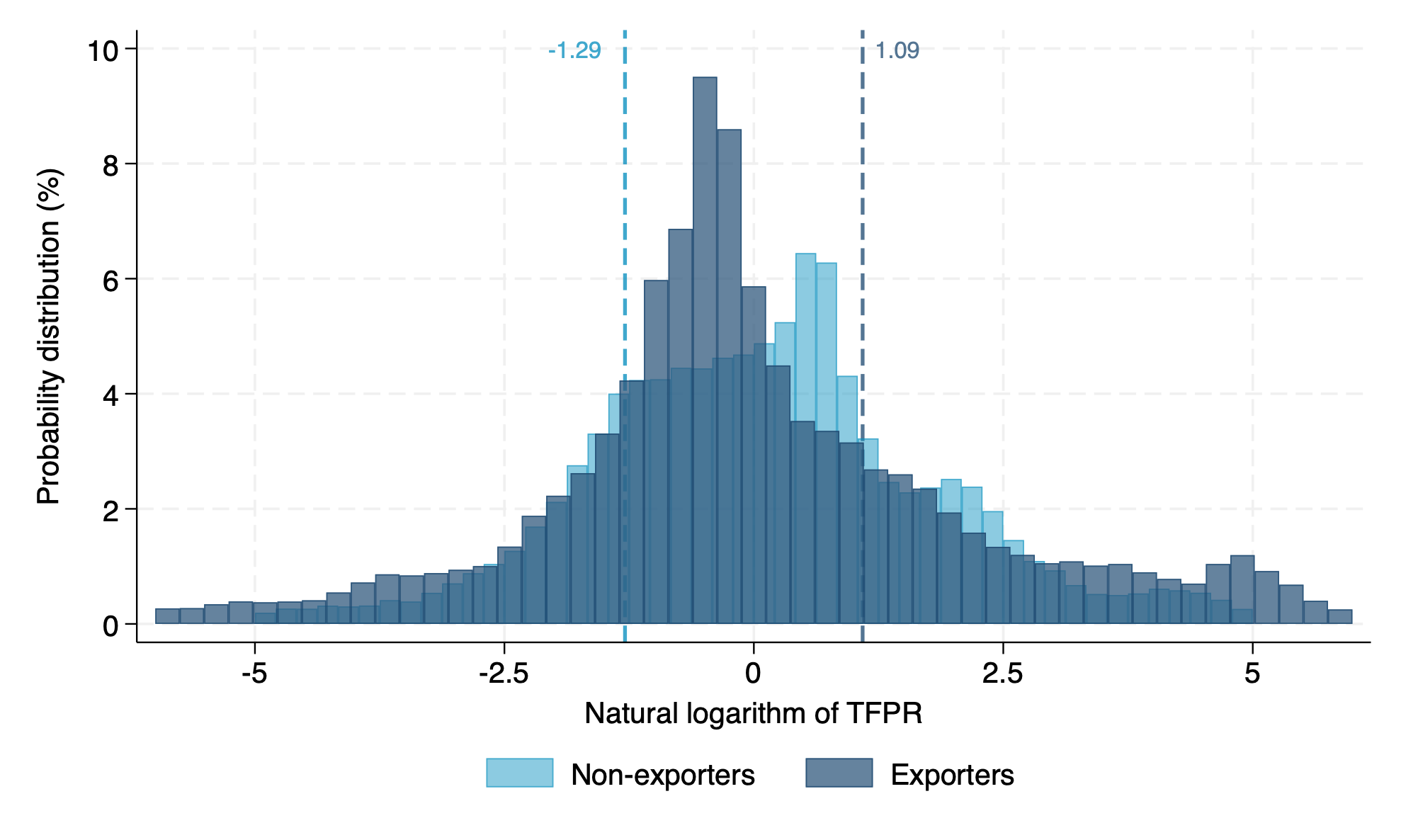
Export Selection, Labour Market Frictions, and Firm Dynamics
Labour Demand Adjustments and Firms' Debt Decisions
with Vasco Botelho and Giulio Nicoletti
Abstract: We study how firms endogenously set their employment and debt decisions when subjected to frictions in both labour and financial markets. With fixed costs of adjustment firms undertake larger and costlier labour adjustments; as a consequence, the looming presence of default risk raises the premium they pay on external finance. By altering the cost of debt, monetary policy actions can interfere in this trade-off between the risk of debt overhang and firms' employment decisions. We first show that the response of employment to leverage buildups is quantitatively and qualitatively different from that of capital. Then, to better understand how monetary policy shocks are transmitted to labour demand via endogenous financial decisions, we set up an estimate a general equilibrium model of heterogeneous firms. Asymmetric fixed cots of labour adjustment play a crucial role in our model: in addition to replicating the employment inaction observed in the data, they prompt firms to take up debt in order to carry out those larger and costlier labour adjustments. Our preliminary estimates show the inclusion of these non-convexities is sufficient to raise average spreads and defaults rates in the model economy.